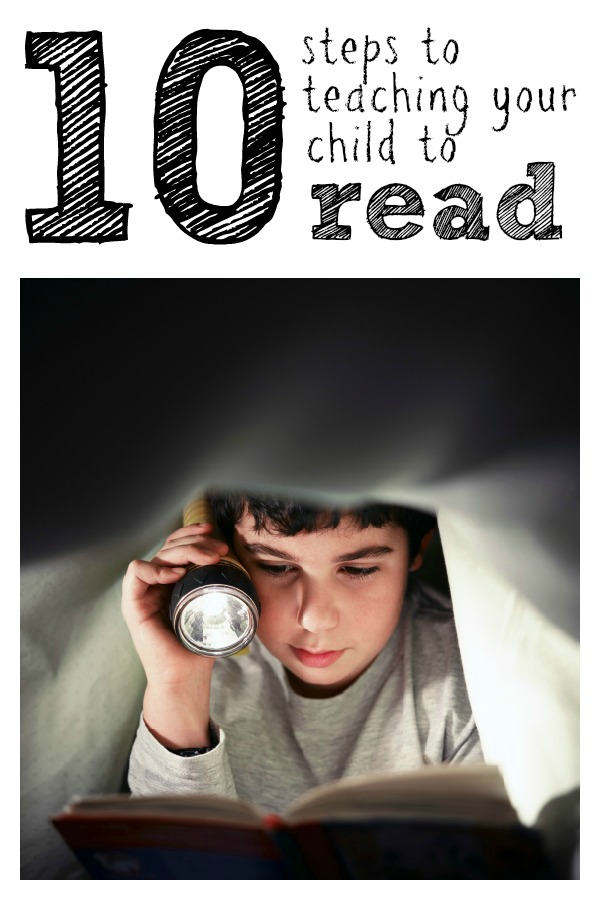
As a former first grade teacher, teaching children to read is one of my greatest passions! But because most children don’t start actually “reading” until around 6 years old (which is upwards of the targeted age range for my blog), I didn’t want parents to feel pressured that their 3-year old needs to start reading (which, by the way, they don’t!). However, the information shared below is general information that is beneficial for children of all ages, whether your child is ready to read or not. Don’t implement all of these strategies at once, nor should you expect your child to be able to do everything right away. It is a process and this information is simply for you to implement when you feel your child is ready.
Please also recognize that although the suggestions below are labeled as “steps”, they are not necessarily in consecutive order, nor are they in order of importance. The information you will find here is simply a guide to help you see how each of the components of reading fit together!
1. Read to your child
Teaching your child to read is truly a process that begins at infancy. (No, I am most certainly NOT advocating programs that claim to teach your baby to read using flashcards!) What I AM encouraging you to do is to begin reading with your newborn within days of welcoming her home! Not only is this a special bonding time for the two of you, it instills in her a love for books. Enjoyment while reading is one of the single greatest predictors of reading success in school-age children. If children don
’t learn from an early age to enjoy reading, it will most likely hinder their ability sometime down the road.
How much you read to your child is completely up to you and your family, but aim to read at least 3-4 books a day, even while your child is very young. As she gets a little older and can sit for longer stretches of time, make it a family goal to read together for at least 20-minutes each day.
Here are a few suggestions for the types of books to read to your child. But by all means, read whatever your child responds to and enjoys!
- Birth-1 Year: Lullabies, Board Books (with real pictures), Cloth Books (with various textures), Song Books
- 1 Year-3 Years: Rhyming Books, Song Books, Short-Story Board Books
- 3 Years-5 Years: Alphabet Books, Song Books, Picture Books, Rhyming Books
2. Ask questions
Asking questions while reading to your child is not only great for encouraging your child to interact with the book, but it is also extremely effective in developing his ability tocomprehend what he is reading. You see, if our main objective in “reading” is getting our child to “sound out” words, we have missed the boat entirely. Even children who can decode words and “read” with great fluency still might not be able to comprehend what they are reading. If a child can’t comprehend what he is reading, there really is no point to reading at all!
While your child is a baby, ask him questions such as, “Do you see the cat?” while pointing at the picture of the cat. This will not only develop his vocabulary, it will also encourage him to interact with the book that he is reading. As he gets older, ask him to point to things in the book himself and make the noises of the animals he sees.
Once your child is about 2 or 3-years of age, begin asking questions before, during, and after reading the book. Show your child the cover of the book and ask him what he thinks it is going to be about (predicting). While reading, ask him what he thinks is going to happen or why he thinks a character made a particular choice (inferring). If a character is depicting a strong emotion, identify that emotion and ask your child if he has ever felt that way (connecting). At the end of the book, ask if his prediction(s) came true. Afterwards, ask him to tell you what he remembered happening in the book (summarizing).
Modifying each of these techniques during read-alouds to meet the developmental stage of your child is a great way to promote and increase reading comprehension!
3. Be a good (reading) example
Even if your child is fascinated with books from an early age, her fascination will quickly dwindle if she does not see reading modeled in her home. If you are not an avid reader yourself, make a conscious effort to let your children see you reading for at least a few minutes each day! Read a magazine, a cookbook, a novel, your Bible…it’s up to you! But show your child that reading is something that even adults need to do. If you have a son, share this article with your husband. Sons need to see their fathers read, especially since it is not something that young energetic boys are naturally prone to doing.
As parents, we can sometimes get wrapped up with what exactly our children should be doing to be successful. But we often forget that children often learn by example. Grab a book and take a load off…for your child’s sake, of course!
4. Identify letters in natural settings
Before our boys were born, we painted and hung large wooden letters spelling their name above the cribs as a decorative accent in their rooms. I would have never guessed that those wooden letters would have such a learning incentive for Big Brother! Around age 2.5, he began asking what letters were above his name. That’s honestly how he learned to spell his name…and he can spell his brother’s name too because he has taken an interest in his letters as well. In technical terms, this is called “environmental print” and includes all of the print we are surrounded by–fast food signs, labels, traffic signs, clothing, magazines, etc.

Often times, we want to force our children to learn letter names by a certain age. We buy flashcards or DVDs claiming to teach our children their letters. We drill our 2-year old over and over for minutes on end. Don’t buy into this…allow your kid to be a kid and take advantage of the “teachable moments” as they come along! Children’s minds are like sponges and are certainly capable of memorizing the alphabet from drilling, but that’s not the most effective method that will produce the best long-term results. Your child will be curious about the print he sees around him and will ask questions. That’s your chance to jump in with a practical application that actually has real meaning and significance to your child.
Don’t misunderstand me and think that I don’t think learning the alphabet is important. It is certainly important…but the method in which we teach them is evenmore important! Always keep in mind that our ultimate goal is to foster a lifelong learner who loves to read, not a child who has simply memorized without any significance.
5. Incorporate multiple domains of developmentChildren learn best when multiple senses or areas of development are included. That’s why hands-on learning produces longer retention and more meaningful application. Once your child has shown an interest in letters and you have already begun to utilize natural settings for identifying those letters, begin implementing activities that incorporate as many senses as possible. Keep in mind that learning letter names isn’tnearly as important as learning their sounds!
There are a plethora of ways to incorporate multiple domains of development in regards to letter recognition and early-reading skills. Alphabet crafts allow your child to learn the shape of a letter along with an association of the sound it makes all the while utilizing fine motor skills in the process of cutting, gluing, and creating! Playing games that involve gross motor skills (like tossing beanbags on the appropriate letter) are also wonderful ways to include movement. Of course, every child loves songs and rhymes! Take an inventory of your child’s strengths and areas of interest and target activities to fit them!

6. Classify the Genre
Once your child is around 5 and can recognize the difference between real and make-believe, I would suggest starting to help your child understand various genres of books during your reading time together. This might seem complicated, but it’s really not. There are around 5 different genres of children’s books that I would encourage you to point out to your little one. Of course you can use the term “type” rather than “genre” if that is easier to remember.
- Nonfiction (real stories or facts about animals, places, people, etc)
- Fantasy (make-believe, can’t happen in real life because of magic, talking animals, etc)
- Realistic Fiction (a made-up story, but it could technically happen in real life because the characters and situations arebelievable)
- Alphabet Books
- Song Books
When children classify a book into a certain genre, they have to first summarize the book in their head and recall details. Then they have to use that information to decide which type of genre that particular books fits into. Finally, your child will be recalling details from other books in the same genre, making connections between the two. This simple activity that might take 5-10 seconds of your time after reading a book but it certainly packs a punch of thought and processing in that young brain!
Also, it’s important to note that not all books will fit into one of these genres, especially books that are considered “phonics readers.” I would suggest that you do this exercise only with high-quality children’s literature, not with books that are attempting to get your child to “sound-out” on their own. Most picture books found in children’s libraries will fit into one of these genres.
Remember, our goal is for our children to learn to comprehend what they’re reading…otherwise reading will honestly do them little good. When we encourage our children to think about and process the book we’ve just read together, we are inadvertently modeling what we hope they’ll one day do independently!
7. Word Families
To put it simply, word families are words that rhyme. Teaching children word families is a phonemic awareness activity that helps children see patterns in reading. This is an important skill because it allows children to begin “reading” by grouping sets of letters within a word. The first part of a word is called the onset and the last part of the word is conveniently called the rime. Word families share a similar “rime” as the onset changes.
Once your child recognizes the word “mop”, he’ll then have an advantage to reading all of the other words that have the same rime (top, pop, stop, cop, hop) because only one letter is changing. Plus, recognizing rhyming words is a great language skill in and of itself!
8. Phonemic Awareness and Phonics
“Phonemes” are the smallest sounds in the English language (go here for a complete list of phonemes). These sounds are made up of consonants, short vowels, long vowels, and digraphs. “Phonemic Awareness” consists of learning those sounds and how to manipulate them within a word. Digraphs are unique sounds comprised of individual letters like /th/, /sh/, /ch/, etc.
“Phonics” includes learning how to spell those sounds and the various rules that the English language follows. Phonics is an important components of reading/spelling, but it should never be the main focus. Again, we are looking to balance our literacy “program” with reading comprehension as the end result. Learning the rules of phonics is simply a tool that helps a child learn to decode and spell. I used the Pathways to Reading program in the classroom as my phonemic awareness and phonics program and loved it! It made learning all of the tricky spellings so much fun, but I wouldn’t recommend it until your child is in kindergarten or first grade.
9. Decoding
Decoding is often referred to as “sounding it out.” This is an important element in teaching your child to read, but it certainly isn’t the most important. Once your child knows the sounds each letter makes (which is taught in real, meaningful situations), she is ready to begin putting words together. When looking at a short word, encourage her to say each individual sound /b/, /a/, /t/, and then put them together “bat”.
As children decode words with more frequency, they will become more proficient at automatically identifying that word. Sometimes this task is tedious, though, so it’s important to find creative ways to make it fun. When I taught first grade, I used to buy little finger puppets that my students could use to point to the letters as they were decoding. This was a huge hit and made this process so much fun!
10. Sight Words
Sight words, also known as high-frequency words, are the most common words in our written language are are often difficult to decode phonetically because they don’t follow the rules of phonics. Because of this, they must be memorized. As I’ve shared with you before, I am not an advocate of rote memorization for optimal learning because I feel it only utilizes the lowest level of cognitive processes. However, sight words must be memorized in order for your child to become a fluent reader. There are a few popular lists of sight words that individual researchers have found beneficial, including the Dolch List and the Fry List. Don’t get overwhelmed when looking at this list…just start working on a few words at a time when you feel your child is ready.
As you’ve probably noticed, there is no “magic formula” for teaching your child how to read. The points we’ve discussed in previous posts have highlighted simple, effective strategies that are easy to modify for your child. After all, every child learns differently! This series is not to be used as a “checklist” and think that once you’ve covered all the strategies your child will be proficiently reading. Rather, this series provides valuable information to you so that you can guide your child while creating a print-rich, learning environment to foster his/her growth as a reader. Don’t rush and don’t stress! While it’s important to take advantage of the prime-learning time, it’s even more important to let your kid be a kid!
In summary, here are some practical suggestions you can implement every day based on the strategies shared with you in this post and previous posts. Obviously, you can’t implement all of these suggestions with children of all ages, so use your judgement about what is best for your child.
- Read to your child every day!
- Ask your child questions before, during, and after reading.
- Let your child see you reading.
- Look for letters while out and about and in the environment around you.
- When teaching letters and letter sounds, incorporate as many senses as possible.
- Read a variety of books and make a game out of guessing the genre.
- Have fun rhyming!
- Work on letter sounds and manipulating them within words (phonemic awareness)
- Encourage your child to sound out short words (consonant, vowel, consonant).
- Practice memorizing a few sight words each day.
- Most of all, have fun together!